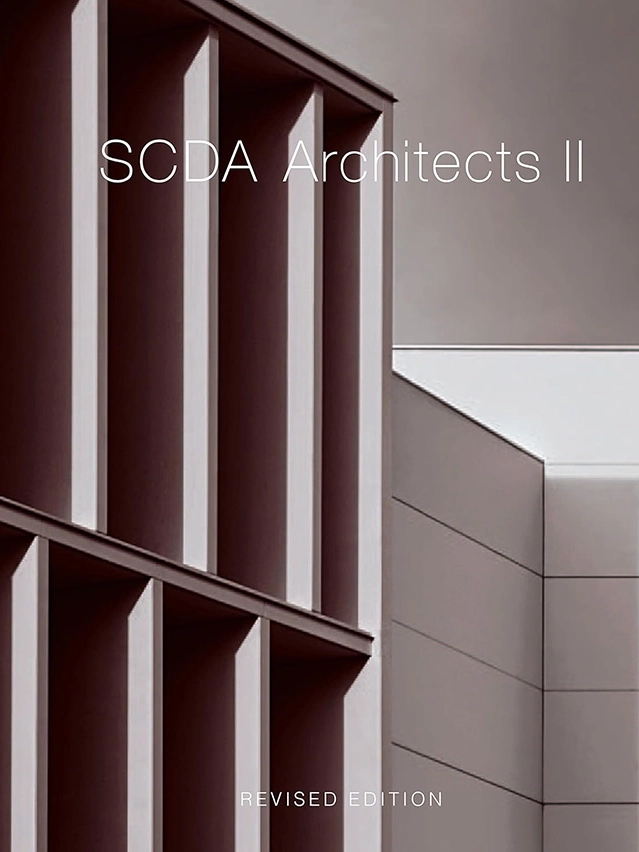
SCDA Architects II (2013)
The Architecture of Soo Chan
In 2006 I reviewed the work of SCDA making an impassioned plea for us to look beyond the surface imagery of the body of work displayed. I asked that critics not appropriate this work to the canons of global architecture, but see it for what it does in its actual contexts. I challenged the notion that this was ‘Pacific Rim’ architecture — and should have dispelled the idea that Singapore is situated on that rim. That would have furthered my case for a much more rigorous critical attention to what the work actually is, avoiding simple categorising.
That essay repays re-reading with this new monograph documenting a further six years of work. The argument needs re-calibration. Then I was concerned that the work — although virtuoso and clearly authored by a powerful hand and eye — had not yet found its own voice and was still somewhat unconsciously embedded in the North American imperium. Perhaps I should have described that, in architecture, as an ‘imperium of taste’. I anticipated that the work of SCDA would need to differentiate itself from that of analogous contemporary practice to whose outcomes the works in the first monograph showed superficial similarities.
There has been a differentiation, but it is not entirely, in fact not at all, the one that I anticipated. I expected the work to spin out of the neo-modernist frame, taking a colouring from the contiguous and teeming architectural contradictions of Singapore and Southeast Asia. Instead it has gone deeper into its purist origins, and in so doing has claimed a different corner of the contemporary architectural discourse from the one that I expected it to fill. In this monograph projects are clustered into hotels and resorts, houses, apartments, commercial and institutional buildings and furniture designs. Absent now are the shophouse alterations that perhaps misled me last time.
There is in this monograph evidence of a breathtakingly even achievement of an architecture that conveys calm certitude, rational compositional ease, the orthogonal organisation of space between horizontal ground, water and sky planes — an oeuvre that occasionally embraces the sinuous in plan or section (W Hotel Seminyak, p.356; Mint Museum of Toys, p.156), but rarely allows inclination (Dhoby Ghaut Green, p.190 being the exception). This is an architecture that dispels doubt, fears of disruption, nightmares of the irrational and the contingent. It is an architecture proclaiming a perfectible universe.
Paging through this new monograph, the mind of this critic races towards a list of precedents, jumping readily to conclusions. Here are pavilions, some classically sedate and seeping references to Mies van der Rohe’s Barcelona Pavilion (Alila Villas Soori, p.300). But here too (Singapore High Commission, p.164) is what appears to be a pavilion in which the parts are held apart in exquisite torsion, the sky plane slightly dished, its tensions seeming to come from its being sprung from an angled side wall leaning away to take the strain of a vast cantilever resting on a single column on the other side. An orthogonally articulated ground and water plane supports a rectangular box and a honeycomb brickwork cylinder. Look from the side however, and this is an entry portico nodding to Le Corbusier’s Chandigarh and not to his Zurich pavilion.
In the monograph there are numbers of masterfully marshalled intersecting box compositions (Lakeshore View House, p.250; Ocean Drive House II, p.268; Belmont Road House, p.258; Grange Road House I, p.276 and Illoura, p.116 among them) and precedents for this extraordinarily accomplished array of manipulations come dimly to mind. These works overshadow their origins comprehensively. There are a number of slightly cranked slab blocks (Tagore Industrial Building, p.198; but also Oberoi and Trident Hotel, p.368) — think Pavilion Suisse via Gio Ponti. There are also village complexes (Project Square One, p.386) and Utzon’s syncopated housing comes to mind.
Indeed there is an urbanity threaded through all of this work that has one reaching to Scandinavian precedents. In this quietly moderated modernism there are resonances with the Louisiana Museum of Modern Art, or St Catharine’s College by Arne Jacobsen. In the SCDA tropical manifestation of this mood there are more pronounced over-sailing roofs (Ridout Road House, p.240), more protected clerestory windows (Alila Villas Soori dining hall), more set-back columnar structures (pervasive), but there is the same urbane and modest civility.
SCDA’s Alila Villas Soori complex main square could be a model centre for a small new town in Finland, not far from one done by Alvar Aalto. The whimsy here and there sets this off, but does not materially influence the general architectural approach. An upturned boat roof in the Maldives (Park Hyatt Maldives, p.328) perhaps makes a slight obeisance to Gehry’s Barcelona Fish. Or is this better read as an homage to Claes Oldenburg’s large tumbling hat blowing through the modernist grids of Chicago, the Windy City? Sculptural incident rather than formal plasticity is the intention.
But these are all my suppositions. The architect does not list the precedents. And as Kahneman points out so vigorously, when analysing complex material we should beware the first ideas that come to mind. There may well be something in all of this, but what happens when we look harder, think harder? The recent research of distinguished architectural scholar Li Shiqiao gives us some pointers here. Looking at this work we must be amazed at how readily internal contradictions are resolved. Never is a column array left hanging, incomplete. Here are no ‘future ruins’, no ‘ruins in reverse’. Never is a box elided with others leaving a lingering question as to which is sliding through which. This is the rational compositional ease I wrote about at the outset. There are few bodies of work around the world that achieve this so consistently and seemingly so painlessly. Close observation reveals a base condition that allows for this seamless resolution: there is always enough space for the logic to play out without contradiction. This is a very unusual circumstance, and it says much for the wealth that has been generated in Southeast Asia in recent decades that this is the case. A mathematical Palladian rationality plays out in these houses—mansions really. A hermetic Arcadian picturesqueness houses these resorts—they do not bump up against the messy ambitions of competing developments. The apartments—often stand-alone, untrammelled by the needs of neighbours—also assert their primacy. The over-scale openings in the Angullia Park tower (p.122) are articulated to give the tower the appearance of a giant ‘toy’, a set of cubes piled up. Even in those buildings where constraints seem to cause a crimping of the plan, or force a concertina pull on the façade, we are left with a resolved figure and no trace of what caused the pain. The architecture is resolved without contradiction, eschewing ambiguity.
What is the mindset here? What can be implied about the author’s mental space? What is the author implying to himself? I suspect, following Li, that this is an idealist mind, one that pictures perfection and that then tries to manifest it through the specifics of projects. This position draws on an imagined perfected world beaming its intentions into our lives where our purpose is to realise that ideal to the best of our abilities. Its light pervades everything, our task is to see its rays and make them manifest. This idealism drives an architectural toolkit. Orthogonal relationships between literal and phenomenal transparency of horizontal and vertical planes, the floating of rectangular volumes and tabula rasa recasting of the ground and water planes, the creation of over-sailing sky planes. Between these carefully composing planes and columnar arrays, perfection can be achieved. Messy reality is edited out. Certainly, as project succeeds project in SCDA’s practice, an ideal city is implied. Regard these works as the complete works of a city—much as renderers used to compose all of the works of an architect such as Sir John Soane into a single city image—what kind of a city does the architect have in mind? It is a very calm, ordered and civil city that suggests itself. Indeed the SCDA city that results from such imagining chimes with the Scandinavian social democracy project, a project that lies at the core of Singapore’s foundation (however tarnished those founding ideals may have become through the emergence in both places of hegemonies of families).
There are two alternative positions that challenge this cool, idealist vision. These are the positions that, as it turns out, SCDA has differentiated its practice against. One, identified by Li, is that of political realism, a position that accepts that reality is a dark mess and then shines a beam of reason into that mess and seeks to ameliorate conditions in their actual context. Rem Koolhaas’ ‘tropical soup’ urban plan strategies that accept that there is an unconquerable tide of informal urban flotsam in the tropical city into which an island of rationality may be floated, can be taken as a contemporary exemplar of this approach. In this approach it is accepted that only limited parts of the city can be resolved, and the juxtaposition between the formally ordered and the organically disordered is celebrated. Those whose work is largely made up of conversions of existing fabric and alterations and additions tend to adopt this view.
Another position, always allied to the idealist and the realist but seldom discussed in architecture, is the libertarian or populist position. Frank Lloyd Wright’s Broadacre City is a founding exemplar, as are his Usonian house designs. The position appeared in art as ‘Pop’ and signalled an openness to everyday consumption, contingent immediate pleasures and a denial of any hierarchy between high and low culture or taste. We see this position in some of the more expressive and exuberant architecture formerly and currently emanating from Singapore.
The last six years of endeavour show that SCDA is differentiating itself away from the realist and populist positions, and becoming ever more adept at the idealist creation of segments of a calm, rationally composed architecture of perfection, achieving a planar architectural paradise supporting the aspirations of Asia’s emerging middle classes, soon to be the largest civil elite in the world.
Leon van Schaik AO
Professor of Architecture
Innovation Chair – Practice Based Research
RMIT University, Melbourne
Modifying Earth and Sky: The Architecture of Soo Chan
In satellite photography, Singapore is seen as a fan-shaped island strategically located between the Malay Peninsula, that appendix to the vast Asian landmass, and the complex archipelago that comprises Indonesia. Singapore is also, famously, a ‘city state’, a term that may conjure up fiefdoms of the Italian Renaissance yet Singapore is a new state, independent since 1965. Today it is one of the world’s most successful nations in terms of health and education, disposable income and rapid economic growth.
Five million people live on an island with remarkably few natural resources. They share a plot of land where space is at a premium: space in its most abstract sense as global environment; space in an intimate, ergonomic sense as square metres per person; and space as the communal space shared by family, neighbours and fellow citizens.
Soo Chan established his practice, SCDA, in Singapore after several formative years in the United States, first at architecture school and subsequently in some well-known professional practices. His fecund output – houses, apartment buildings, resorts – is situated not only in Singapore but across Southeast Asia and increasingly the wider world. Yet the realities of Singapore, its benefits and challenges, infect the work of SCDA, fusing close attention to personal space with a concrete concern for communal experience.
Life on Earth
Throughout Soo Chan’s work, one notices certain key characteristics, whether the projects are private and domestic or high-rise and in public view. There’s attention to geometry, a sense of architecture as the composition of discrete vertical and horizontal planes. This attention is devoted to structural elements such as retaining walls and roof slabs yet also to smaller components of construction such as treads of dramatic staircases and the fin-like louvres that filter the strong Singapore light.
There’s a sense of architecture as formal composition, of what Le Corbusier in Towards a New Architecture (1923) called the skilful, accurate and magnificent play of masses seen in the light; but also a concern for sensory mechanism, an invitation to dwell and linger in these interior and exterior spaces. Many if not all components of construction are seemingly in play, creating patterns and texture. If the finish of natural materials and the repetition of components appeal to our human senses of touch and sight, water introduces a third human sense, sound.
This evocation or harnessing of nature is particularly germane in the context of Singapore. Land there is expensive; every square centimetre counts. Furthermore Singapore is tropical, blessed with extraordinary flora and lush foliage. A central tenet of Chan’s architecture is to prioritise the ground plane, to hold the earth’s surface, or a carefully balanced facsimile of it, as the focus of design intent. This is evident in the many elegant villas with their axial pools and shaded terraces. More startling, and more radical, is Chan’s replication of these conditions in high-rise apartment buildings.
The architecture of SCDA pushes the boundaries of normative construction, testing ideas at the scale of the individual house and applying this information, this sensory knowledge, to much larger projects – buildings of metropolitan consequence.
Chan’s manipulation of, and delight in, geometry is apparent in several of the villas. At Ridout Road House (p.240), for instance, we see the characteristic interplay of vertical and horizontal, opaque and porous planes. ‘Vertical and horizontal planes’ is of course a sculptural, plastic way of thinking about walls and roofs. The entry façade of Ridout Road House includes white monolithic walls that fold to become roofs, walls of horizontally striated grey stone, and a long horizontal façade of dark vertical louvres.
Observe how these various planes meet, sliding past each other to evoke continuous space or held by bracketing walls so as to reveal, in sharp outline, the section profile. Here a single tree rises through a square aperture in the extensive canopy that hovers almost magically in space. In Chan’s world, specimen trees are talismanic elements, the focus or origin of plans. On occasion, trees mysteriously emerge from cubic incisions in dark reflective pools. Elsewhere, trees are held high above ground level as symbols of nature many storeys in the air.
As one moves into the more private zones of these houses, walls lighten to become colonnades, an idea of architecture as pavilion that has resonance with both European modernist prototypes such as the pavilions of Mies van der Rohe and indigenous, often ceremonial, structures across Southeast Asia, structures that offer protection from direct sunlight and frequent downpours of rain.
The resolution of thin canopy roofs is a critical detail in Chan’s pursuit of an elegant geometric ideal. Their fascias are super-thin sandwiches or superimposed strata of building material. In the unusual case of the Singapore High Commission in New Delhi (p.164), the soffit or underside of the great ceremonial canopy slopes down from a razor-like perimeter.
And then there’s water, extensive pools that are ornamental, that are planned for exercise and leisure, and that cool the ambient temperature.
At Harbourview House (p.222) the refinement of walls as either opaque planes or almost invisible membranes results in an extraordinary composition, in places transparent like an x-ray (another modernist trope), in places screening interior spaces from unwarranted exposure. Some prominent façades are incised with horizontal fenestration slots – Le Corbusier’s fenêtres en bande – that retain the primacy of the planar element yet allow panoramic views out from the interior.
Especially noteworthy at Harbourview House is the seeming elevation of these façade elements up into the air. They exist as hovering planes suspended in space, defining space, meticulously detailed players in a multi-dimensional collage. Although much of Chan’s work appears chthonic, to emerge from the earth, and to devote close attention to ground surface, there can also be the perception of suspension, both of primary elements of construction and of what we might consider secondary elements, in particular stairs.
Indeed, as at the Botanika apartment building (p.42), staircases are typically a spectacular feature of interiors by Soo Chan. At Botanika, a spiralling open-riser stair is held by an outer swoop of delicate tubes; this most generous staircase is inserted into space as a kind of kinetic ornament. These are ‘specials’ with some of the glamour of 1950s Italy (Carlo Scarpa, Franco Albini) and of Eero Saarinen’s interior architecture for General Motors near Detroit.
In several of Chan’s residential buildings, double-height units are linked by tauter spiral staircases, devices reminiscent of those in Le Corbusier’s Paris interiors of the 1920s – these are sculptural elements inside purist, orthogonal volumes. Le Corbusier’s famous description of the house as ‘a machine to live in’ is often interpreted as a reduction of the domestic world to crude functionality. In fact, Le Corbusier may have been thinking in a much more holistic way, considering the full life and human use of architectural interiors.
Chan knows his history, the story and example not only of ‘high modern’ architecture but also such slightly earlier manifestations of integrated design as the Wiener Werkstätte whose architect members designed candlesticks, plates and cutlery. It is in part Chan’s attention to intimate details and finishes that seems, paradoxically, to have allowed SCDA to jump in scale from individual houses to skyscrapers.
Structure in the Sky
This Singaporean architect is drawn to the culture of inter-war Paris and the work of designers such as Émile-Jacques Ruhlmann, Jean-Michel Frank and Pierre Chareau. Ruhlmann and Frank are renowned for interiors with luxurious yet minimal furniture within a balanced architectural vision. Chareau is best remembered today for the radical Maison de Verre in which bathrooms, storage elements and electrical switches all play a role in the total ensemble – he has been categorised as an architecte-meublier, raising the profession of cabinet maker and interior designer to rarefied heights.
Chan also attends, even obsessively, to the key contents of his interiors. The chairs and tables. The light fixtures. The bathtubs. These are invariably both minimal and sensuous; they are geometry yet exhibit innate qualities of the natural materials used. This notion of what the Viennese termed gesamtkunstwerk, the total work of art, appeals to Chan’s aesthetic interests. Furthermore it serves a very useful role in the growth of his practice, allowing SCDA to stretch in scale from residential work to major commissions for hotels and resorts where comfort and distinctive imagery are highly valued.
This characteristic pleasure in detail, in the assembly and display of components, hits a particularly high note in the façade and interiors of the Mint Museum of Toys (p.156). The façade consists of vertical glass fins, each with a curving outer rim such that the building expresses itself to the outside world as a crystalline wave, at once calibrated like a machine and playfully reactive to light. The interior is also about light and lightness. The collection of toys is arranged on minimal shelves suspended in space and artfully illuminated.
Off Orchard Road in Singapore, The Luxe (p.72) also boasts an artistic glass façade. The lower box-like protrusion is sealed in a flush, contiguous skin of glass etched in a white abstraction of trees in silhouette. It’s an unusual project for SCDA; nevertheless it incorporates the practice’s characteristic concerns for fabrication, light and nature; albeit nature, in this case, as metaphor.
At many of the villas and inside many of the apartment complexes, nature is highly organised, manicured and artfully presented. The communal garden at Nassim Park Residences (p.102) is an attractive mix, on subtly differentiated levels, of paths, terraces, pools, trees and precious patches of grass all caught between low parallel walls. To this first-time visitor, the ensemble seems to be not simply a question of accommodating programme but to have symbolic resonance amid the towers and traffic and infrastructure of Singapore.
From the terraces above (some have private lap pools), the layout of the communal space below is like a striated verdant carpet. There’s an echo, perhaps unintended, of Frank Lloyd Wright and the way Wright enticed the users of his architecture to slip between walls, to take momentary detours (left, right, up, down) before the revelation of primary spaces. Wright also of course loved natural materials – stone and wood – and the benefits of planting.
Soo Chan does not settle for plants at ground level only. Many of his mid-rise and high-rise residential buildings are marked by the presence of private gardens on all levels. This was a modernist dream: casting small plots of paradise high in the air. Chan goes further by integrating not only gardens but small swimming pools up through several of the buildings – The Boulevard (p.64), for instance, in Singapore and One KL (p.50) adjacent to the Petronas Twin Towers in Kuala Lumpur.
At One KL, pools are perpendicular to the façade with a single pane or window at each outer end, thus creating an exterior checkerboard of aqueous screens. The elevations of One KL reveal an architectural strategy of stacking solids and voids. With the Katana building (p.36), also in Kuala Lumpur, and with the soaring towers of Skyterrace @ Dawson (p.96), apartment units are not only stacked but interlocked. This allows for a range of unit sizes, for dramatic double-height spaces high above the ground below, and for the cooling benefits of cross-ventilation.
In such ambitious buildings, residents enjoy private apartments that both evoke cosmopolitan glamour, exposed to the outside world via sheer glass walls and cantilevered terraces, and offer the security or shelter of what might be termed ‘caves in the sky’. The vertical and horizontal accumulation of these units with their projections and erosions instigates a figuration of solid and void that allows each unit its legibility while giving the collective form scale and character.
If the interlocking section is again reminiscent of Wright (think of the subtle modulation of roof planes at Fallingwater), Chan’s proposal for a prismatic monolith at Angullia Park (p.122) is a truly radical vision. The tower is made from five cubic elements stacked one above the next within a sleek perimeter. The monolith is eroded to reveal multi-storey voids that function as vertiginous terraces or eyries with extraordinary views of the Singapore skyline. These open rooms are like garden pavilions enlarged and raised into the clouds.
Sustainability and Comfort Today
“I have begun to think that regionalism is what happens automatically, coming out of the needs of the place.” This is the reported opinion of Geoffrey Bawa (Mojaloa Arkitek, January–February, 1990), the architect responsible for many very beautiful houses and hotels in what was once Ceylon. “If you take local materials and the general feel of the place into account,” Bawa continued, “the resultant building automatically becomes regional.”
In our contemporary world – with international consumerism, instantaneous information and the worrying depletion of natural resources – architectural culture is more global and subject to more rapid change than the proselytisers for modernism could ever have envisaged. The legacy of Le Corbusier, Mies and Wright has certainly filtered through time and across continents. Cognisant yet independent of this Western canon, architects such as Bawa, Luis Barragán in Mexico, and Roberto Burle Marx, the Brazilian landscape architect, offer a model of progressive design that taps into and magnifies regional characteristics.
Singapore, like other Asian cities, is today a driver of the international economy and a crossroads in our global network of finance, communications and leisure. Many of Soo Chan’s buildings, and certainly his interiors for restaurants and galleries, are commissioned for their appeal in this increasingly sophisticated market. His clients are undoubtedly conscious of vanguard design and design standards worldwide. Conversely, there is also an interest in augmenting specific aspects of each place, local qualities that can make a well-designed project stand out from its commercial rivals.
From the industrial aesthetic of the 1920s to recent computer-generated environments, human comfort has often seemed at odds with rational modernism. For architecture and design to become integrated with society, buildings — their self-presentation in the world, their interior spaces, their fixtures and fittings — need to better engage their users, many of whom now aspire to a green agenda. Sustainability is in this sense not only a matter of technical data but, furthermore, the holistic inclusion of human life in the built world.
Connecting the human body with the wider world, comfort today incorporates a respect for materials, the inclusion of nature, an adaptability to climate. Contemporary comfort is also increasingly concerned with exercise and wellbeing. The work of Soo Chan communicates such concerns for pleasure in the world with responsibility for its future, for the fabrication of environments that appeal to our essential human instincts and desire for a healthy lifestyle.
In the busy centre of Singapore, the diaphanous structure in the linear garden known as Dhoby Ghaut Green (p.190) is an unusual work, functionally speaking, in Soo Chan’s oeuvre. It’s a serpentine pavilion intended for public gatherings (dhoby means washerman, ghaut a large open space) sheltered by an encircling, basket-like wall and partial roof. Like much of Chan’s work, however, the ground is moulded, dipping in this case down into the earth, screened by a wall of woven aluminium ribs and topped by a halo of sensuous hardwood.
Such understanding of wall as fabric, as weaving, was critical to the theories of Gottfried Semper a century and a half ago. Semper’s other categories included masonry for ground work — the floor as heavy and permanent plinth — and carpentry for roofs — the ceiling as canopy against the sky. Similar attention to wall-as-skin is manifest in the work of architects as diverse as Frank Lloyd Wright and Cesar Pelli. The latter is best known for his high-rise buildings, notably the Petronas Twin Towers, and their calibration of membrane detailing. Conversely Wright’s strategy was almost always horizontal, extending laterally to embrace the landscape.
With the Alila Villas Soori (p.300) on the southwest coast of Bali, Soo Chan has realised a remarkable synthesis of domestic pleasures, evident in so many of his houses, and the bravura pragmatism necessary for the many mid- to high-rise structures realised by his practice. The hotel and spa is assembled from pavilions and houses that seemingly grow from the ground and offer privileged views of the sky and ocean.
The complex is laid out like a three-dimensional carpet: geometric, organic, in places ornamental. The buildings and open spaces descend gently with the contours towards the sea, facilitating views and, in the process, drainage from adjacent paddy fields. This occasionally staggered, axial relationship with the horizon line is interwoven with a perpendicular series of walls and lanes, one of which connects everyday village life with a temple precinct on a nearby promontory. Several small temples have been constructed within the new complex to further connect the resort with its hinterland.
The resort is in many ways a little city, breaking down the scale of the complex into lanes, pockets of communal space, canopied interiors open to the views and breeze, and glimpses of luxuriant gardens. Alila Villas Soori lies several hours’ travel time from Singapore; nevertheless it is not, I think, an exaggeration to suggest that this and other resort projects by SCDA manifest lessons waiting to be applied in Singapore and in other dense and complicated urban conditions. These are projects that pay homage to nature and the earth’s surface even as their silhouettes modulate the sky.
Raymund Ryan
Curator, The Heinz Architectural Center
Carnegie Museum of Art, Pittsburgh
SCDA Architects II (2013)
SCDA Architects II (2013)
In 2006 I reviewed the work of SCDA making an impassioned plea for us to look beyond the surface imagery of the body of work displayed. I asked that critics not appropriate this work to the canons of global architecture, but see it for what it does in its actual contexts. I challenged the notion that this was ‘Pacific Rim’ architecture — and should have dispelled the idea that Singapore is situated on that rim. That would have furthered my case for a much more rigorous critical attention to what the work actually is, avoiding simple categorising.
That essay repays re-reading with this new monograph documenting a further six years of work. The argument needs re-calibration. Then I was concerned that the work — although virtuoso and clearly authored by a powerful hand and eye — had not yet found its own voice and was still somewhat unconsciously embedded in the North American imperium. Perhaps I should have described that, in architecture, as an ‘imperium of taste’. I anticipated that the work of SCDA would need to differentiate itself from that of analogous contemporary practice to whose outcomes the works in the first monograph showed superficial similarities.